
Proof Carrying AI: Can Your AI Survive Scrutiny?

Every organization is chasing the same prize: a single point of truth it can act on. When traditional software fails, the failure usually looks broken. A page crashes, a number refuses to load, a report comes back blank. Everyone knows something went wrong because their eyes quickly caught the error, and then it registered in the brain.
A large language model fails differently. It can deliver a wrong answer in fluent prose, with citations, confident language, and a step-by-step explanation attached. The answer may rest on a stale policy, a source that copied another source, or a quotation stretched past the truth of what was actually said. Nothing about the output signals a failure, making the failure harder to catch.
Enterprise AI has entered the phase where the differentiator is whether an AI-assisted decision can survive scrutiny. An auditor, a regulator, a program manager, or a court will eventually ask how the system reached its conclusion. Five questions decide whether the answer holds up:
- Can the system identify every material claim it made?
- Can it trace each claim to exact evidence?
- Can it tell independent corroboration apart from repeated amplification?
- Can it explain how confidence changed as new evidence arrived?
- Can it prove the conclusion obeyed the rules, the time boundary, and the jurisdiction that governed the question?
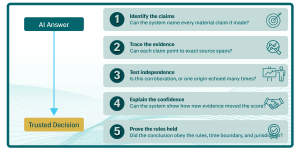
Figure 1. The five questions every AI answer must survive before it becomes a trusted decision.
Few AI deployments today are built to answer even the first question. Prompt engineering will not close that gap. The fix must come from the architecture itself.
Consider a question about whether a policy applies today. A retrieval system can surface a document that is topically perfect and two revisions out of date. The passage is relevant. It may even seem to support the answer. It is still wrong, and nothing in a similarity score will say so. Relevance, support, independence, temporal validity, and logical acceptability are five different properties, and a system that measures only the first will fail on the other four in ways that look completely confident.
Accuracy Is a Property of the Architecture
Language models are optimized to generate plausible continuations. Keeping an enterprise-grade ledger of what is actually true is a separate job, and the architecture must explicitly assign it. Retrieval-augmented generation helps a model find relevant material, but relevance is only the first of five distinct properties. Does the material support the claim? Is the source independent? Was the claim valid at the requested time and place? Does the conclusion follow under the governing rules? Each property needs its own signal, and a similarity score only supplies candidates for the first.
The emerging answer is a proof-carrying control plane: a set of shared services that surround the model. The retrieval layer finds possible evidence. A truth engine weighs it, discounting copies and calibrating confidence. A proof engine applies hard rules that no confidence score can override. The language model does what it does best: interpret intent and synthesize clear language. The system of record lives outside the model, in services anyone can inspect and test.
The separation of duties is strict by design. The model may propose a claim; certification comes from the proof engine. Evidence services may establish candidate support; the decision to answer, qualify, abstain, or escalate is governed by a versioned runtime policy. And because risk varies, the control plane runs in modes. Ordinary knowledge work gets fast retrieval with claim support checks. High-assurance questions require independent evidence families, full provenance, and valid proof before release. Forensic review gets a workspace holding the contested evidence paths and their change history.
Trust Becomes Something You Can Measure
This separation turns trust from a brand attribute into a testable service-level objective. The retrieval team can measure evidence recall. The data team can measure provenance completeness. The model team can measure the extraction error. The risk team can assess whether a stated 90% confidence level is actually correct about 90% of the time. When trust is measurable, it can improve.
Calibrated abstention deserves special mention. Executives tend to resist it at first, and auditors tend to value it most, because a system that knows when to withhold an answer, and can show exactly why, carries real weight in a regulated environment. The architecture treats withholding as a measured, defensible act.
The payoff shows up where it matters most: in the review meeting. Instead of reconstructing how an answer came to be, a reviewer opens a structured evidence packet and inspects it directly. Fewer unsupported claims, honest disclosure of contested evidence, and faster human review follow from the design itself.
Over the next three articles, this series unpacks how a proof-carrying system works: the proof receipt that travels with every high-stakes answer, the math that catches a hundred sources pretending to be independent, and the hybrid model architecture that makes it all affordable at scale.
The more convincing an AI answer sounds, the more rigorous a test it deserves, and architecture is what lets it pass that test.

John "JT" Robinson
Chief Technology Officer
Get to the Core of More
Discover how Kentro helps organizations build AI systems that not only withstand scrutiny but can redefine the standards of trust and transparency.